Loading...
Serving Blacksburg, VA and surrounding areas. (540) 418-8765
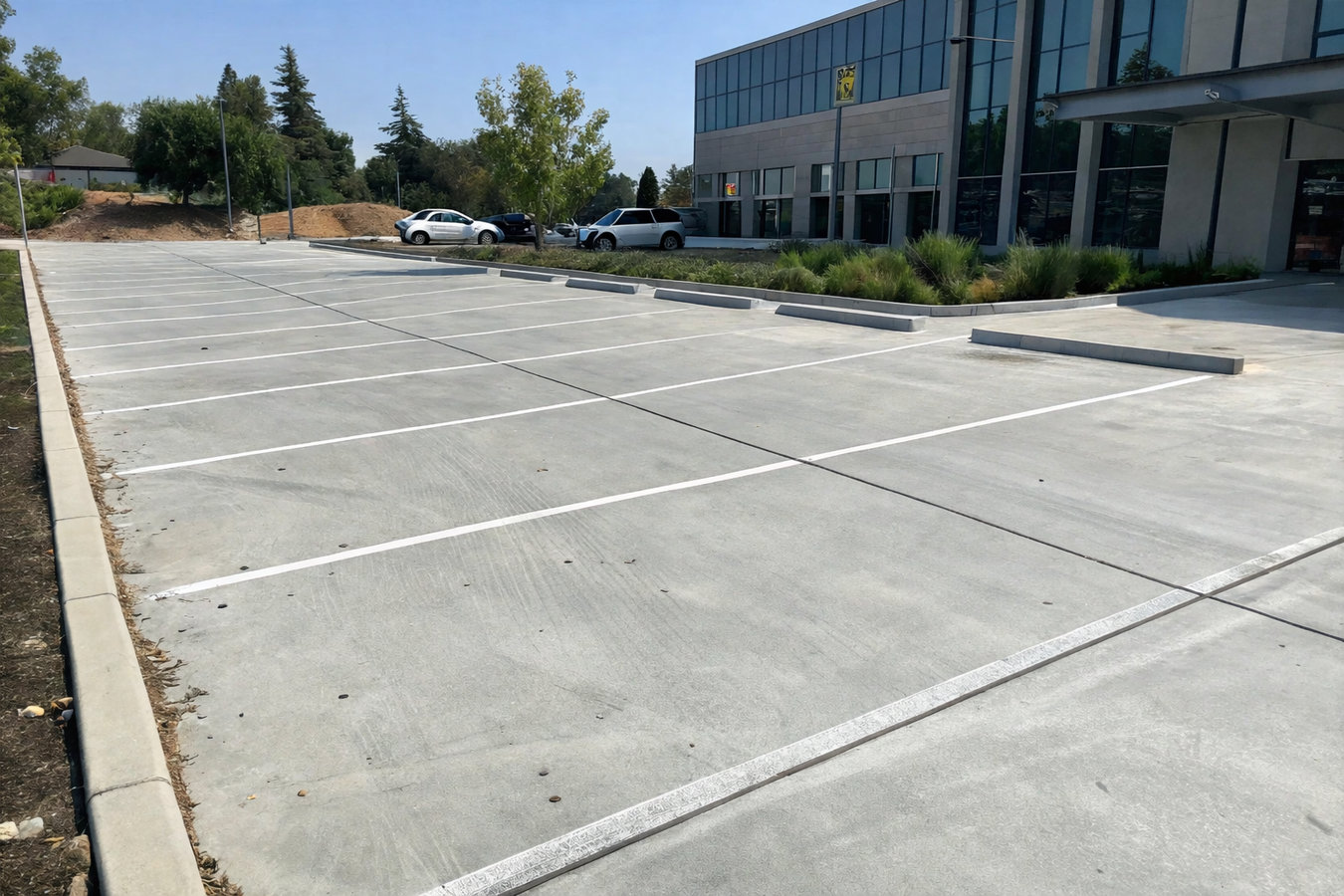
Gravel turns to mud every winter and asphalt cracks every spring. A properly built concrete lot handles Blacksburg's freeze-thaw cycles, clay soils, and hilly terrain without the constant patching. We handle the grading, base prep, pour, and permits.
Concrete parking lot building in Blacksburg involves grading the site for drainage, compacting a gravel base, setting forms, pouring reinforced concrete, and cutting control joints - most residential or small commercial lots take two to five days of active work plus a curing period before driving on the surface.
If you have a gravel or asphalt surface that has become unreliable - rutting after rain, cracking every spring, or just wearing out after years of use - you already know the problem. Blacksburg's elevation means the ground freezes hard every winter, and surfaces that were not built for that cycle show it quickly. The fix is not another round of patching. It is a concrete surface poured over a properly prepared base that can handle the seasonal stress this area puts on pavement.
For property owners who also need paved access from the street, our concrete driveway building service uses the same base preparation and mix design and can often be scoped alongside a parking lot project to reduce total site work.
If your parking area becomes soft, rutted, or muddy every time it rains or snows - and in Blacksburg that happens regularly from late fall through early spring - the surface is not holding up. Mud and ruts damage the underside of vehicles and make the area unsafe. A concrete lot solves this permanently and holds up through the freeze-thaw cycles that make unpaved surfaces so unreliable in this climate.
If you have had cracks patched and they keep reappearing in the same places, the underlying base is likely failing, not just the surface. Repeated cracking in the same areas - especially if the edges are uneven in height - means the ground beneath is shifting. At that point, a full replacement with a properly prepared base is usually more cost-effective than continuing to repair.
Standing water after a rainstorm means the surface was not graded correctly or has settled unevenly over time. In Blacksburg's hilly terrain, this is a common problem on older lots where the original grading did not account for how the ground would settle. Pooling water speeds up surface damage and creates a slip hazard in winter when it freezes.
If you have built or are planning a garage, rental unit, workshop, or small commercial space, a defined concrete parking area makes the property more functional and more valuable. In Blacksburg's rental market - driven in part by Virginia Tech - well-maintained properties with solid parking surfaces tend to attract better tenants and hold their value over time.
Every parking lot project starts with a site visit. We walk the property to assess the slope, how water currently drains, the condition of any existing surface, and how equipment will access the area. In Blacksburg, that site-specific understanding is not optional - the terrain here means two properties a street apart can have very different grading and drainage requirements. From there, we handle excavation, gravel base compaction, forming the edges, the concrete pour, surface finishing, and control joint cutting. For lots that will see delivery vehicles or heavier loads, we design the slab thickness to match the use. Every project includes proper concrete footings or sub-base work as needed to ensure the surface has a stable foundation beneath it.
We manage permit applications with the Town of Blacksburg and coordinate any required stormwater review. For property owners who need both a parking area and connected driveway access, we can scope both as a single project to minimize disruption and reduce setup costs. The American Concrete Institute provides technical guidance on concrete pavement design and best practices at concrete.org.
For homeowners replacing gravel or asphalt surfaces, or adding paved parking alongside a new garage or detached structure.
For rental property owners and small business operators who need a durable, low-maintenance surface that handles regular vehicle traffic.
For properties with existing paved surfaces that are past the point of repair - full removal, base correction, and fresh pour.
Blacksburg sits at roughly 2,000 feet in the Appalachian highlands, and the town regularly sees temperatures dip below freezing from November through March. When water gets into small cracks or beneath a slab and then freezes, it expands and pushes the concrete apart - a cycle that repeats dozens of times each winter. That means the concrete mix has to be designed for freeze-thaw resistance, and the timing of your pour matters. Concrete poured in cold weather without proper protection can end up with a weak, flaky surface that fails before its second winter. Parts of the Blacksburg area also have clay-heavy soil that expands when wet and shrinks when dry, making base preparation more involved than a straightforward gravel-and-pour operation. A contractor who does not account for local soil conditions is one of the most common reasons parking lots crack within a few years here.
We complete parking lot work throughout the New River Valley, with regular projects in Christiansburg and Radford. The same freeze-thaw conditions and sloped terrain that make Blacksburg lots demanding apply across this region, and we bring the same site-specific approach to every project regardless of location.
We schedule a time to walk your property and look at the slope, drainage, existing surface, and equipment access. You will receive an itemized written estimate within one business day of that visit - no phone quotes that change when the crew shows up.
If your project requires a Town of Blacksburg permit - which is common for new paved surfaces - we handle the application and build the approval timeline into your project schedule. You do not have to navigate that process yourself.
The crew clears the area, excavates to the required depth, and compacts a gravel base. This step determines how the finished lot performs over time. You will need to keep the area clear of vehicles and stored items during this phase.
On pour day the concrete is placed, finished, and control joints are formed or cut. Plan to keep vehicles off the surface for seven full days, and heavy vehicles for about 28 days. We walk the finished lot with you before we leave and explain what normal wear looks like in the first year.
Free on-site estimate. We handle the permit. No obligation.
(540) 418-8765We use concrete mixes designed for the repeated freeze-thaw stress that hits this area every winter. The base preparation accounts for Blacksburg's clay soils and elevation - not a generic spec sheet from somewhere with a milder climate. The result is a surface that performs the same in March as it did the October before.
The Town of Blacksburg requires permits for new paved surfaces, and the stormwater review can feel overwhelming if you have never done it before. We pull every permit, submit every plan, and coordinate the required reviews so you never have to worry about a stop-work order or a compliance issue after the fact. Virginia's contractor licensing requirements are verified through the state's DPOR system at{" "} dpor.virginia.gov.
Blacksburg's hilly terrain means drainage is not an afterthought - it is the difference between a lot that lasts and one that fails within a few years. We grade every surface so water moves away from your building and off your property the right way, not toward your foundation or a neighbor's yard. The first heavy rain after the job is done confirms the work was done correctly.
Every estimate we provide breaks down excavation, base material, concrete, and finishing separately so you know exactly what you are paying for. We walk your specific property before quoting - phone estimates in Blacksburg's variable terrain are not something we offer, because they are not accurate enough to be useful.
From base prep through final walkthrough, every parking lot project we take on is built for the specific conditions on your property. That means a surface you can actually use without worry, not one that requires attention every spring.
The buried concrete pads that anchor posts, columns, and additions - essential before any structure goes up on your property.
Learn MoreResidential concrete driveways sized for passenger vehicles, built with the same freeze-thaw-resistant base as our commercial lots.
Learn MoreConcrete season in the New River Valley fills up fast - reach out now to lock in your project date before the spring rush.